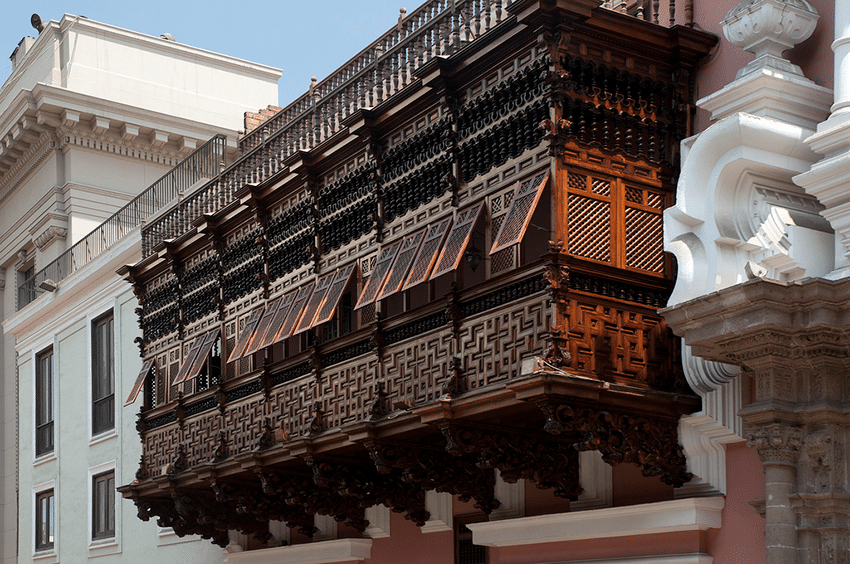
The balconies of Lima represent a cultural heritage of incalculable value**, which took shape during the Spanish colonial regime and the Republic of Peru. Many of these balconies, all built between the end of the 17th century and the 18th century**, are still in excellent condition and can be admired in the center of Lima: currently adapted for residential purposes have, with their peculiar aesthetics and fundamental historical value, influenced the life of many Peruvian scholars, as the famous writer of the 19th century Ricardo Palma.
The wooden balconies of Lima** were the crucial element that prompted UNESCO to declare the entire city centre as World Cultural Heritage. From a constructional point of view**, these splendid artifacts refer to the so-called colonial architecture, which developed in the Viceroyalty of Peru between the sixteenth and nineteenth centuries, that is, at the time of the conquest of the Latin American nation by the Spanish. The balconies are a heterogeneous example of many different styles: from the one renaissance to the baroque, from the neo-baroque to the neoclassical. Moreover, their originality comes from the fact that these styles are never pure, but always conditioned by the cultural journey of the period: here therefore there are influences markedly Mediterranean, Middle Eastern, Moorish, Andalusian and Caribbean.** The most Renaissance and Baroque styles are clearly to be attributed to the European presence in the country. The Renaissance idea that the nobility of a palace characterized the very greatness of the entire city** permeates, in total, the entire architecture of the historic center of Lima. In particular**, the baroque architecture** of the period, characterized by decorations with great scenic impact and remarkable exuberance design, is prevalent in the balconies still visible today. The eighteenth century brought with it, in Lima, the triomph of the Rococo style, influenced by the French presence on the territory. The result was original and overwhelming architectural ornaments**, characterized by a clear playful footprint. An example is House Goyeneche, built in 1863, brilliant demonstration of the heavy French hand in the design of the buildings of the time. But there is more: the pot-pourri typical of the historic center of Lima and of the entire Peruvian architecture denotes also a marked Arab influence. The same wooden balconies, also known as ..miradori
From a purely designal point of view, the wood balconies of the centre of Lima are characterized by inlays and cross-linked, as well as by important balustrades. Their unique conformation not only guarantees an excellent visibility of the exterior, but also a great privacy for the observer and an excellent circulation of the air , this is absolutely fundamental in such a warm and sultry territory. social function of the balconies of Lima has changed over time, with the changing of culture, politics, history. In the 18th century these artifacts were usually used by the Viceroys to communicate with the settlers. If they were used as a Abbot, they served as a privileged observation point of the population, with the guarantee of not being seen. And there is more: the balconies of Lima became famous as a center of countless romantic encounters for women of the most affluent social classes, who thus had the security of remain protected by indiscreet looks (although not from the gossip). They can be considered in this sense a real manifestation of the dynamics of social power, since they illustrate the marked distinction that has always characterized individuals belonging to different classes. balconies are the point of union between the interior and the exterior of the city of Lima, and create a perfect fusion between family spaces and collective spaces " characteristic," provided by the typical Islamic architecture. It is therefore no wonder that these artifacts have been compared to "roads of the sky" in their function of connecting private houses with roads. Antonio de la Calancha and Juan Meléndez coined this term, and wrote: "There are so many and so many broad roads that they look like suspended roads in the air."
To view videos, enable external content in your cookie preferences.