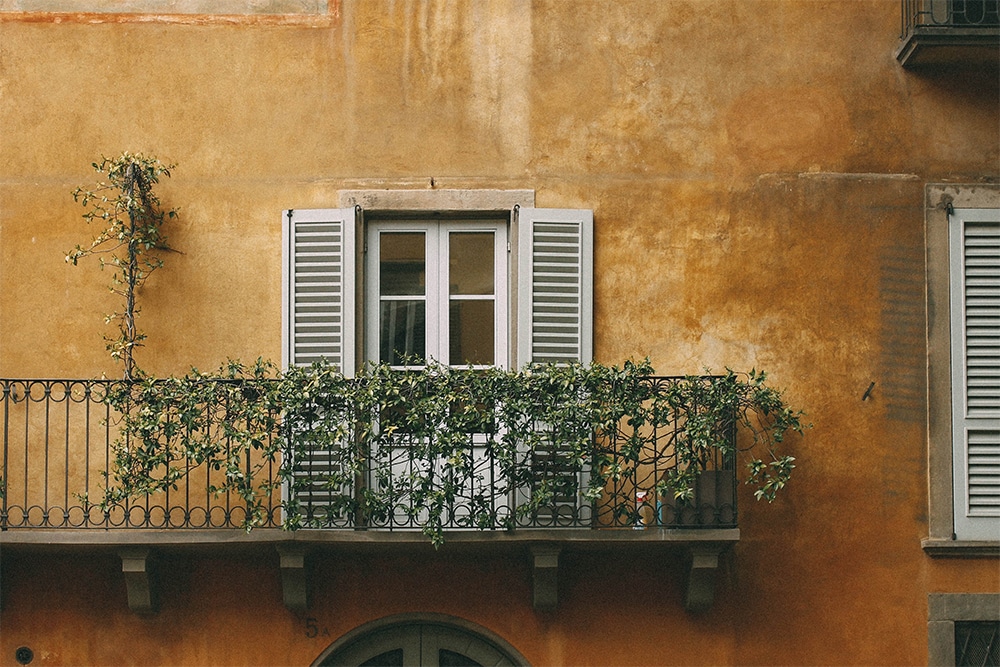
Over the months, we have examined with the utmost attention the topic balconies and terraces, architectural elements that exceed the centuries and trends adapting, both in technological and stylistic terms, to a primary necessity of man: that of identifying an border area between the interior and the exterior. The balcony, or terrace, are therefore made instruments through which to enter into communication with the world while maintaining the sense of security typical of the domestic walls.
Balconies that assure, inspire, fascinate** and contribute to the dream and meditation, to creativity and to the structure of ideas and projects, therefore. Parts of our daily life that have also influenced the work of many artists and writers, so much so that they have found placed in their compositions in the course of history. We have selected for you the best quotations on balconies and terraces: phrases, aphorisms and thoughts that will fully restore the rêverie of those who have conceived them.
In the scent of May afternoons and peaks on the diaphanous nights of the fiery summer, when Palermo, drunk of the intense scents of its conca, ferocious and warm, seems a languorous udalis, sick of love, balconies, open to the fresh sea breeze, soft and pathetic sounds of harpsichords spread into the fragrant air or in a vast terrace, embalmed by the intoxicating smell of the jasmine of Arabia, a soft voice of woman, accompanied by a The song was a soft and lamentable pinch of guitar, singing, in the sweet silence of the starry night, a mixed Sicilian chanting, all sobbing and tears and sighs.* * The author is Alessio Di Giovanni, Italian poet and playwright (1872-1946), characterized by a production mainly in Sicilian dialect and by scenarios that reflect the population of the Ciancia between the end of the nineteenth century and the beginning of the twentieth century. •At first sight is a house like the others. But if you look well you will notice that nobody ever enters or leaves the number 23 of Leinster Gardens, in London, and no one ever appears at the window. The door has no bell or hole for letters. Thousands of people pass every day in front of this strange house without realizing that it is all a fiction. ♪ The house that does not exist ♪ was built by the London Metropolitan Railways because some officials believed that it was the best way to hide the entrance of a subway tunnel without spoiling the architectural harmony of the street. For this reason the facade of a fake house, even if doors, balconies and windows are true, was superimposed on a concrete wall. ♪ ♪ Reader's Digest Selection, March 1985. The author is Nino Lo Bello (1922-1997), American writer and journalist specializing in writings on the Vatican and the arts for the New York Herald Tribune. He was also known under the pseudonym of Walter Hoffman. • Memory is a balcony from which he critically observes the world • • Excerpt from the intervention at the Sila Prize •49, 2014. The author is Luca Rastello, Italian writer and journalist (1961-2015). Graduated in philosophy, he was sent Diario, director of Narcomafie and collaborator of Republic. He is remembered above all for his activity in the international cooperation. • Stamani I rose at 4:45 am and I put myself on the balcony of my room to see the dawn on the Etna. His color was silver and purple over a delicate redness, which seemed vermilion inside. On the top a snow diadem, and underneath, the necklace of the clouds. The great height of the mountain did not appear such because of its soft and long sides. • • Quote in Rina La Mesa, Foreign Writers in Sicily, published by Cappelli, 1961. The author is Bernard****Berenson, historian of Italian and naturalized American art (1865-1959).He is considered the uncontested authority in the attribution of Renaissance works.
There, from the enchanting balustrades of a Romanesque balcony or from the mysterious threshold of a gothic portal, which merges the sun sleeping in the shadow of the large trees surrounding it into the illuminated darkness of the church, we must continue to see the procession coming out of the multicolored shadow sloping from the stone trees of the aisle and take into the countryside, between the tarch columns, surmounted by capitals of flowers and fruits, those paths of which we can say, as the prophet said of the Lord: * "Citation of the French writer, essayist and literary critic (1871-1922). His most famous work is of course the monumental novel "Alla Ricerca del Tempo Lost" (The Search for Lost Time), published in seven volumes between 1913 and 1927.
To view videos, enable external content in your cookie preferences.