It is commonly thought that balcony, terrace and veranda are almost synonymous terms, but it is not. Each of them precisely identifies a specific type of artifact, and it is therefore essential to understand the various differences in order to focus exactly what we seek and desire from our home.
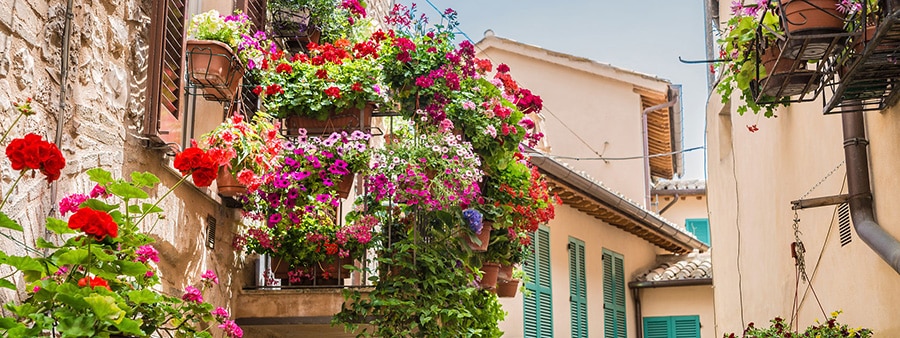
We can assume that, of course, balcony and terrace have something in common: both are external architectural elements, generally equipped with parapet. However, there are much more characteristics that distinguish them. Let's start with the balcony that, to be defined as such, must protrude from the building. On the contrary, the terrace is an integral part of the building and is, by law, considered a living space. In fact, the terrace has an average size much larger than a balcony (20 square meters or more). Unlike the latter, it is also equipped with flooring and generally without covering. However, it may happen that the terrace is equipped with special roofs, which can be easily removed and at the discretion of the occupants: for example, the terraces built on the paved roofs of the buildings, sometimes partially covered by shelters. In addition to the aesthetics, balcony and terrace are divided into two parts for their intended use. The balcony is usually a long and narrow architectural space and is limited from a point of view of the useful surface: it does not allow the possibility of use of the spaces ideal. The terrace, on the contrary, thanks to its greater extension is more suitable for the carrying out of activities so-called social activities, such as outdoor dinners or small events.
If we were to refer to balconies and terraces using specific adjectives, we would choose . . . . . . . . . . . . . . . . . . . . . . . . . . . . . . . . . . . . . . . . . . . . . . . . . . . . . . . . . . . . . . . . . . . . . . . . . . . . . . . . . . . . . . . . . . . . . . . . . . . . . . . . . . . . . . . . . . . . . . . . . . . . . . . . . . . . . . . . . . . . . . . . . . . . . . . . . . . . . . . . . . . . . . . . . . . . . . . . . . . . . . . . . . . . . . . . . . . . . . . . . . . . . . . . . . . . . . . . . . . . . . . . . . . . . . . . . . . . . . . . . . . . . . . . . . . . . . . . . . . . . . . . . . . . . . . . . . . . . . . . . . . . . . . . . . . . . . . . . . . . . . . . . . . . . . . . . . . . . . . . . . . . . . . . . . . . . . . . . . . . . . . . . . . . . . . . . . . . . . . . But not only that: it is in fact a peculiar artifact that can be realized even starting from an open porch or even from a balcony. What distinguishes it above all from a balcony or terrace is that, presenting wooden or metal structures, with fixed or openable windows, produces an inevitable increase in the volume of the property and an aesthetic alteration to the facade of the building.
For this reason, the veranda can be realized only after consulting with an authorized professional, such as an architect, an engineer or a surveyor who, according to municipal regulations, will know whether there are the conditions for the intervention. Another characteristic that distinguishes the veranda from the terraces and balconies is its closure on all four sides. It goes without saying that, precisely for this peculiarity, the veranda can be a perfectly livable and absolutely comfortable environment even during a winter or rainy day. Finally, some etymological curiosity.
The term "balcony" comes from the ancient German "balk," "balken" meaning beam or "balcony" meaning "bala-chaneh" which can be translated into a high or protruding place in the house, from which it is possible to observe the surroundings.
As for
And which one do you prefer between the veranda, terrace and balcony? Which one would you choose for your home?
To view videos, enable external content in your cookie preferences.