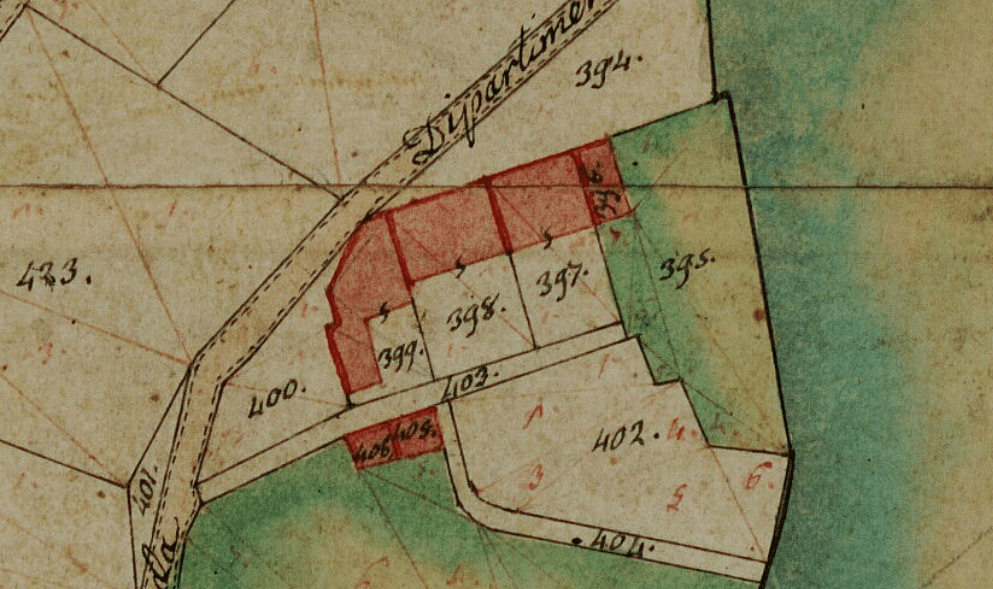
What is the restaur, if not a breath of life in a long-sleeping artifact? And where does this breath of life come from, except from the deep understanding of the peculiarities that make up a artifact, which make it unique, special, worthy of being returned to the history of the present? It is not by chance that, for our work of restauro conservativee of the splendid Palazzo Ferlendis, historical building in the beautiful Lover, we started from knowledge in its broadest sense. And the knowledge was hidden in the archives that traced the history of centuries that had affected the palace. Study is the preliminary operation always necessary, vital, to the realization of any manual work. That's why the accurate reading of historical archives was preventative to the assembly of any scaffolding, to the choice of materials, to the definition of specific interventions and, of course, to the restoration operations proper. The history of a building is very different from its walls, which are solid and perceptible. Invisible, hidden, often dusted. In our research, we have identified important ideas in the Napoleonic and Lombard-Veneto** (- ‐ ‐ ‐ ‐ ‐ ‐ ‐ ‐ ‐ ‐ ‐ ‐ ‐ ‐ ‐ ‐ ‐ ‐ ‐ ‐ ‐ ‐ ‐ ‐ ‐ ‐ ‐ ‐ ‐ ‐ ‐ ‐ ‐ ‐ ‐ ‐ ‐ ‐ ‐ ‐ ‐ ‐ ‐ ‐ ‐ ‐ ‐ ‐ ‐ ‐ ‐ ‐ ‐ ‐ ‐ ‐ ‐ ‐ ‐ ‐ ‐ ‐ ‐ ‐ ‐ ‐ ‐ ‐ ‐ ‐ ‐ ‐ ‐ ‐ ‐ ‐ ‐ ‐ ‐ ‐ ‐ ‐ ‐ ‐ ‐ ‐ ‐ ‐ ‐ ‐ ‐ ‐ ‐ ‐ ‐ ‐ ‐ ‐ ‐ ‐ ‐ ‐ ‐ ‐ ‐ ‐ ‐ ‐ ‐ ‐ ‐ ‐ ‐ ‐ ‐ ‐ To complete a survey that, by force of things, can never be truly all-embracing, we finished our study with deepening on historical residences in the Lombardy area sculpting through acts of formation, maps, summary, transports of eximum, books of lottery, as well as notary acts that included detailed descriptions of the environments and even inventories of their furnishings.
It was a ** preliminary work of monumental scope**, and yet it proved to be of indescribable value, not only because it allowed us to know more in detail the origin of Palazzo Ferlendis, but also because it has somehow** transported us into a past now very distant**, immersing us in its atmospheres, expectations, ambitions, hopes and peculiar needs. And it is in all this parterre of answers, sometimes clear, sometimes confused and conflicting, that we have found the origin of the building that we were called to bring back to life. Follow us in this travel through the centuries of Lombard history. Sources*. State Archives of Bergamo, Napoleonic Catasto, Lovere, Transport Estimo, 60 and 61; Catasto Lombardo-Veneto, Lovere, Books of match between the properties Piccinelli and Biancotti (starting from 904). Archivio di Stato di Milano, Catasto, 9683 e 9684 (Acts of formation). Collection of Demetrio Oberti di Lovere. About Lovere: Alberto Bianchi e Francesco Macario, Locchio della storia, La city edizioni 2016; Giovanni de Lezze, Description of Bergamo and its territory, c. 260v e c. 261v (Lucchetti, 1988); Roberto Ghilardi, When in Lovere they built cars in I thank Demetrio Oberti di Lovere; Laura Businaro, *Mauro Livraga,Marinetta Pacella ed Emilia Peduzzo dell'Archivio di Stato di Bergamo.
To view videos, enable external content in your cookie preferences.