What are the origins of Palazzo Ferlendis**, the historical building symbol of Lovere which, recently, has been restored to its ancient splendor thanks to an accurate work of restauro conservative that also interested Schiavi Spa? According to the documents of the archives, Palazzo Ferlendis rises on the current Via Guglielmo Marconi, between the Lago d'Iseo and the ancient road direction, today renamed Via Cesare Battisti. The historical Lupin humus that sees the birth of the building is to be found in the conditions of serenity guaranteed by the Peace of Lodi, sanctioned in 1454, and in the consequent confidence in an expansion of historical and economic increasingly marked, which concerns the Bergamo territories annexed to the Venetian Terraferma. It is the time to Lovere to exit outside of its medieval walls, expanding its village beyond Valvendra, in order to guarantee urban support for the new and increasingly numerous manufacturing activities.
In this context, the Ferlendis family** begins to build in the Marza village, just outside the town, creating a site of residence and processing of the scarlet cloth** and expressing, with lime and bricks, the economic fervor of the time**.
In the eighteenth century, the building is then split into several properties** but it does not change its structure, which continues to face entirely on the wonderful lake thanks to a single vegetable garden, which will remain so until 1828, with the construction of the new coastal road in the direction of Breno and Edolo. Where now there is a fuel station c" was once a large meadow in mulberry-planted hill, owned by the Zitti family. Where there is now a parking lot overlooking the lake, there was once a vegetable garden with vines (and again, mulberry trees), owned by the Gerosa sisters. It is time, for Palazzo Ferlendis, to become almost a small village inside the village, with different appliances and houses for rent that the many particles and maps are divided.
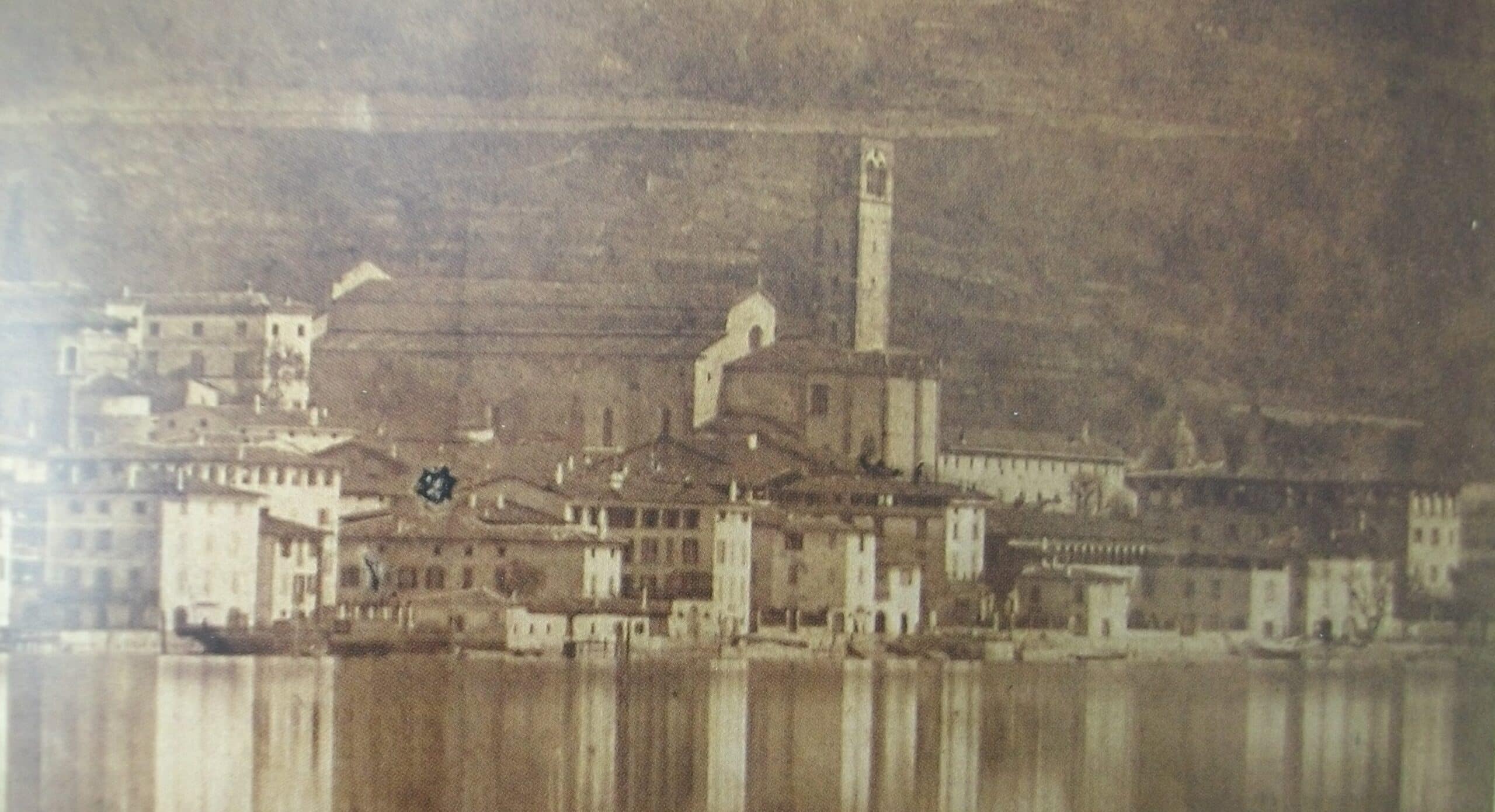
He is the prefect of the Municipal Gymnasium of Lovere, lbate Domenico Puccinelli, who unify and order the entire site again when he gets the property of some lots. The historical building remained for a long time a ** residence with tavern, stables on the ground floor and warehouses**, but the Pincinelli Abbot remains however as the figure of a joint for the cadastral story of Palazzo Ferlendis, finally devolved to the Municipality of Lovere in 1853. Another seller, the town hall finally re-composes the integrity of the ancient building. Thus begins a new stage of his secular history. Lovere's photographic panorama taken from the Album of documents and other people praiseworthy who passed to better life, Lovere 1881- Foundation Academy of Fine Arts Tadini Onlus. Museum of the nineteenth century. Thanks to the director Marco Albertario. *FONTI: Archivio di Stato di Bergamo, Catasto Napoleonico, Lovere, Trasporti Estimo, 60 e 61; Catasto Lombardo-Veneto, Lovere, Libri partatori tra le proprietà Piccinelli e Biancotti (starting from 904). Archivio di Stato di Milano, Catasto, 9683 e 9684 (Acti di formazione). About Lovere: Alberto Bianchi and Francesco Macario, L'occhio della storia, La city edizioni 2016; Giovanni de Lezze, Description of Bergamo and its territory, c. 260v e c. 261v (Lucchetti, 1988); Roberto Ghilardi, When in Lovere they built the cars in . ..Il Giornale di Bergamo-Oggi , 30 June 1987 in copy at the Collection Demetrio Oberti; SirbeC, ARL card edited by Luca Scaburri, 2007. About the Abbot Domenico Piccinelli: Almanac Royal Imperial for the provinces of Lombardo Veneto, 1825 and sqq.; Carlo Facchinetti, Bergamo or both Novizia patrie
To view videos, enable external content in your cookie preferences.