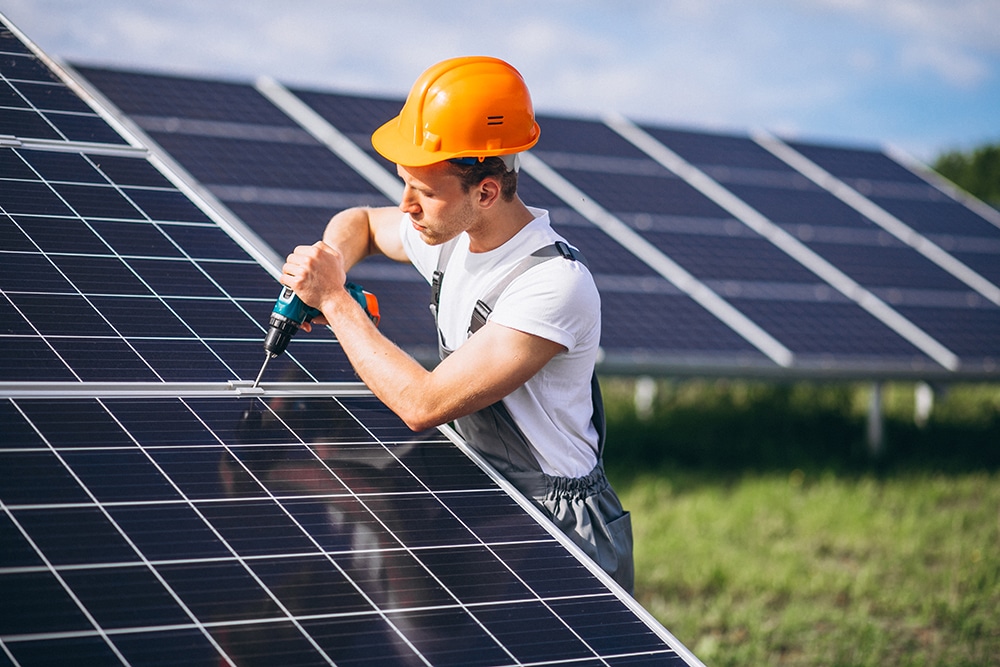
Why are revamping and repowering two key activities to keep ** photovoltaic plants** healthy? The reason is simple: in a historical moment when the systems of clean energy supply are experiencing a sort of second youth, the average age of the photovoltaic park of our country increases and it is therefore necessary to operate correctly for the plants to maintain performances for a long time. We know today for sure that solar energy is now more and more widespread in Italy, so much so that represent an important percentage of the national energy mix**. In this context, it becomes vital to acquire the correct behaviour to extend the life and performance of photovoltaic systems as much as possible, not only to reduce the costs of maintenance, disposal and replacement**, but also to burden less and less on the environment in terms of ** ecological footprint**.
The average life of photovoltaic systems** is currently at ** over 8 . 10 years**, and this figure becomes particularly interesting if we think about the systems installed in the 2009-2011 period**. If, on the one hand, the most technologically evolved and installed plants do not yet present problems of vetusity, it is advisable to intervene on those purchased during the first solar energy boom maintaining them correctly. It should be remembered that, without the necessary maintenance operations, a ** photovoltaic system loses progressively power** and can no longer perform as it should (it is said that annual efficiency loss varies between 0.4 and 0.6%). Revamping and repowering intervene in this sense, favoring an increase in the ** total installed power.**
Photovoltaic revamping The photovoltaic revamping** is defined as the maintenance process of the plant with the aim of improving its efficiency**, bringing its performance to a good level or even to the initial ones.
Photovoltaic revamping can be carried out in several ways depending on the criticality presented by the plant or its particular characteristics: it can therefore involve the replacement of some components, such as modules, or the repair operation on damaged areas.
It is particularly useful for plants that were quite old** because, about ten years ago, they used materials and technologies that were now considered outdated and less reliable than the current ones, which should ensure a better and more prolonged level of performance**.
Together with the new construction technologies, in recent years the mode of investigation on existing plants have been consolidated, in order to ensure more precise and effective interventions for problems such as overheating of cells, power losses, broken panels, or simply the degradation of materials. At the same time, photovoltaic revamping is necessary when the plant is not more compliant with the reference standards and one or more of its components are to be replaced for this reason (for example for the ** termination of their warranty**).Another of the most typical interventions in the context of PV revamping is represented by the replacement of the inverter. At the same time, a ** monitoring system** that will keep an eye on the emergence of any new critical issues may also be installed to improve the management of the plant.
This is photovoltaic repowering As for photovoltaic repowering**, it is an intervention that has the objective of increasing the nominal power of the installed plant and therefore its energy production. This can be done either by modifying the components of the system that replacing them, without going to act on the plant in its entirety. This is a more accurate and exhaustive intervention than the previous one, because it aims to optimize the maximum operation of the plant and even, at best, allowing it to overcome the initial performance. In practice, the repowering photovoltaic moves in parallel with changing the energy needs of the inhabitants. It is important to bear in mind that the GSE has set some limits for the upgrade of solar power plants and that, consequently, the repowering photovoltaic should always be performed by a specialized technician.
In conclusion, photovoltaic repowering is also the standard procedure for modernizing existing systems by inserting in them more current and technologically evolved components that increase the performance of the modules. Among these components, stand out in particular the accumulation batteries
To view videos, enable external content in your cookie preferences.