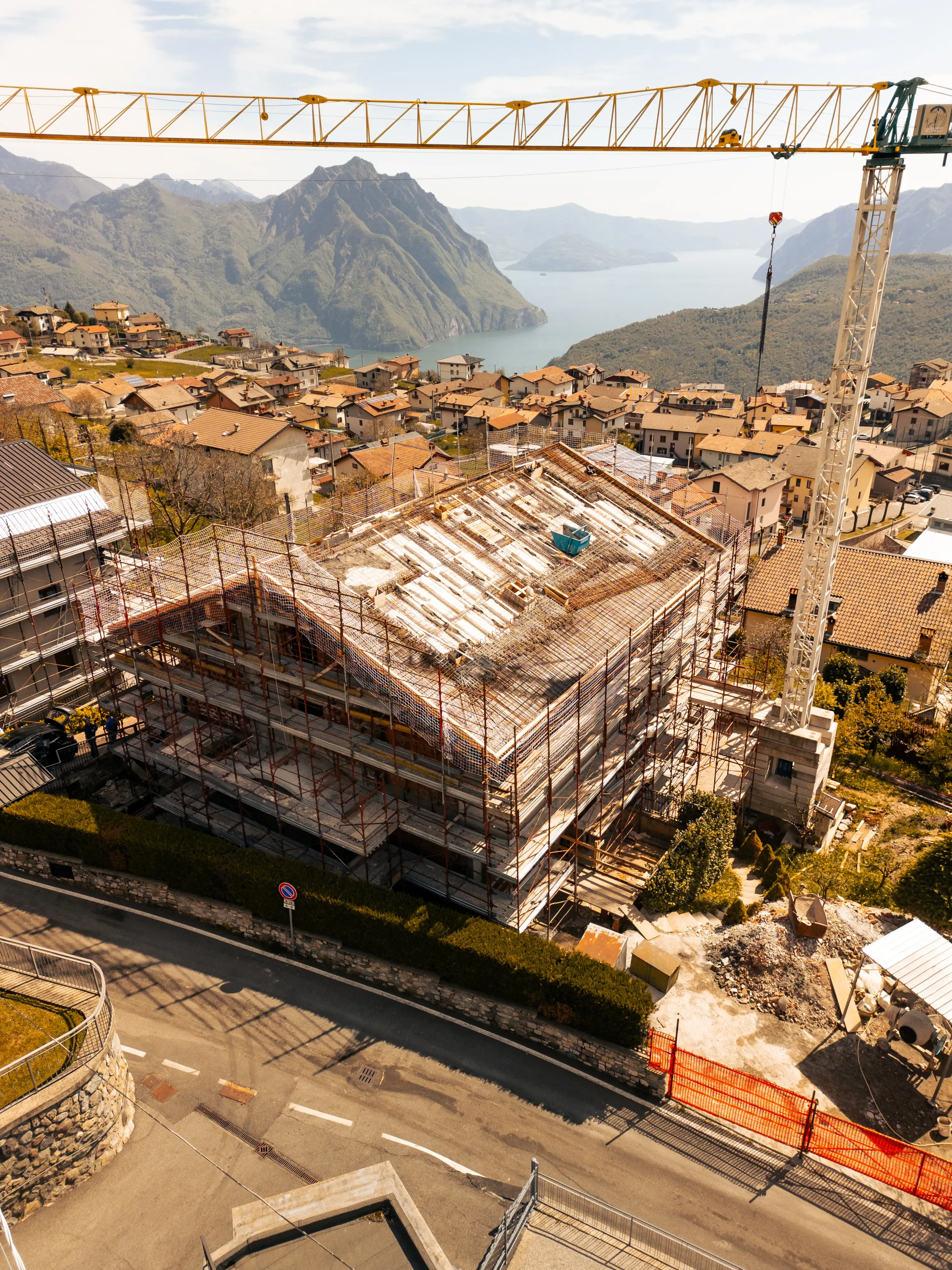
*** By Elena Forin, art critic and independent curator.*** Among the municipalities of Bossico and Lovere, in a plateau happily overlooking the landscape of Lake of Iseo, there are some houses built from the second nineteenth century by high-bourgeois families of the area. The peculiarity of these buildings does not reside so much (or only) in the architectures, as in the history and honomastic choice that connotes them. Each of them bears the name of a Roman hill**, a place linked to the eternal city or to Risorgimento events: those who built them have expressed openly their political and patriotic ideal, taking sides in favour of the unity of Italy, and Rome as the capital city. Campidoglio, Aventino, Celio, Esquilino, Palatino, Quirinale and Viminale, but also Vatican, Gianicolo, Pincio, Caprera, Glori and Quattro Venti tell one of the many ways in which democratic and republican values emerged in those years, and testify to the commitment and participation in their time of nineteenth century entrepreneurship, then become a model for the successive generations, which still today in those places and in continuity with the past, support the spirit of the present.
This is the case in the case of Villa Aventino, a later construction than the others: it was built in the early 10th century by the wishes of Ventura Gregorini, and was designed in a sort of "colloquio" with Villa Vaticano, built in the second half of the 19th century by Giovanni Andrea Gregorini, the founder of the Lovere ironworks and belonging to the same family of the Aventino. The Ventura Gregorini also come from the steel world** , and in fact the Vatican's book collection (passed to the owners of the Aventine) is composed of volumes, donated to the ** civic library of Lovere**, mostly technical, which testify to an international competence and an interest in mineralogy, mechanics and industrial chemistry, as well as collecting sources from the solid European and Risorgimento imprint.
The Bossico Aventine was a happy place to be also seen in the theme of liberal arts: since the 1930s, besides being the place of appreciation and listening to opera music, the Villa becomes the crucial center for a nourished group of artists: in fact, it recalls the local journalist and illustrator Narciso Bonfadini, that Villa Aventino, equipped with the most refined comforts, is a small temple of art. The canvases of the heel, the Trussardi, the Oprandi and other Masters cover the walls of its halls for the most chosen enjoyment of the spirit. And it is easy to hear there good musical performances: like that which, a distant night in May, filled with stars and loves, I felt flowing from the open windows and spreading in the woods to wake up the fairies of the most beautiful childhood fairies for dances.
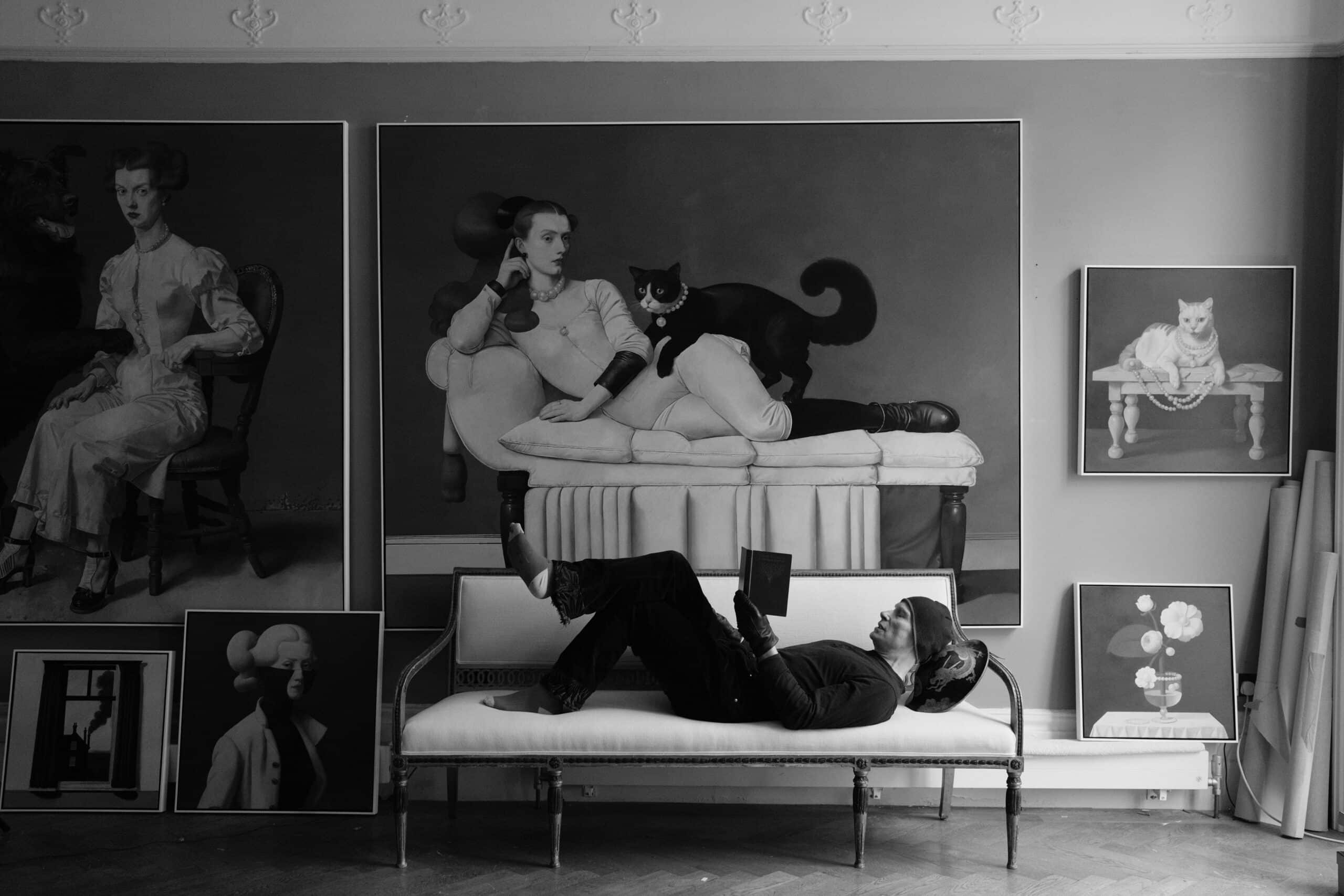
This is the atmosphere in which many works are born**, inspired by the tranquility of the place, its expansive views and cultural nourishment offered by the Ventura Gregorini: among these also the small canvas of Giorgio Oprandi which starts the most recent project of the Villa, and which involves three exponents of the universe of contemporary painting .
Back from long journeys to Africa and Albania, Oprandi is restored to Bergamo, and since the 1940s of the 20th century, he has dedicated himself to landscape painting, finding in his nativeity Lovere and in the nature of Sebino the privileged sources of his painting. Some testimonies tell him about his first weapons, in these places, as a lyrical poet of the landscape, but also as a frequenter of the meadows and pine forests: his relationship with the space and with the feeling of the plateau is also evident in the small work of the early The painting, through relaxed and soft touches, transmits a calm and luminous atmosphere, governed by a serene balance between a sweet and harmonious nature, and the discreet presence of man. This minute jewel of poetry, was the reference point from which they started Alici, Grones and Tocca: each of them has in fact transmitted in a work similar to that of the twentieth-century master, the different nuances detected in the context, returning not only three visions, but also three different temperatures.
!](/assets/imported/c77cfa9442-D750606.jpg)
!](/assets/imported/6c42bdfaa2-D750603.jpg)
!](/assets/imported/435722bb62-D750593.jpg)
!](/assets/imported/2da3327846-D750595.jpg)
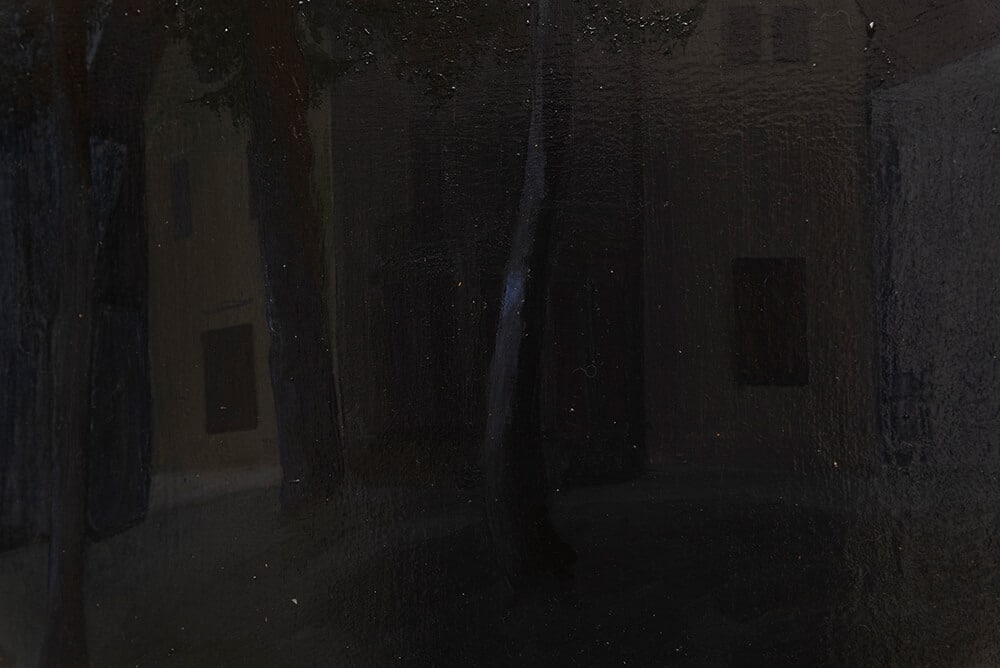
Villa Aventino for Beatrice Alici** (San Donà di Piave, 1992) seems to have grasped the magical spirit that spread from the Villa for Bonfadini and woke the fairies to lead them to dance: his is a Aventine wrapped in that darkness that precedes the dusk, or in the sleep of the day towards the night. There is no darkness in this night, and it is the most collected sense of nature to be expressed in the intimacy of the wood caught through the moonlight. The artist has been busy for a long time on the meaning and suggestions of this moment, since, as she herself says, she set her works in the night without having full consciousness, gradually coming to capturing the lunar temperature composing mostly through scales of grey and green to accompany more or less powerful explosions of light: after having again experienced the color and its notes even bright, in this and other recent works the Alici returns to choose a few color tones of which it verify nuances and gradations.
This road, which had travelled even more clearly at the time of the Academy in which he entrusted the design with the task of translating his own visions, led him to elaborate a concept of magic and fantastic which is also found in the atmosphere of the painting of the Aventine, in which a feeling evoked by atmospheres and original and almost primordial lights takes shape.
The space is not portrayed faithfully, and indeed corresponds to a vision created by the artist, which framed in the canvas a glimpse of the Villa wrapped in trees that are actually just beyond, but not in direct proximity to architecture. To have impressed Alici in fact, it is the vastity of nature surrounding the Aventine and the type of landscape that winds around this: the compositional process was born from a series of shots that framed the Residence and that were used to provide it with respect to the context, which in the painting immersively embraces the body of the building. The artist's vision also suggests the approach to the house from the back, from its private and secondary perspective, far from the officiality of the front and the formal reception: the evocative tenor of the colors also lets glimpse the windows of the bovindo overlooking nature, built to enter with the gaze into the middle of the wood, its mystery and its magical creatures.
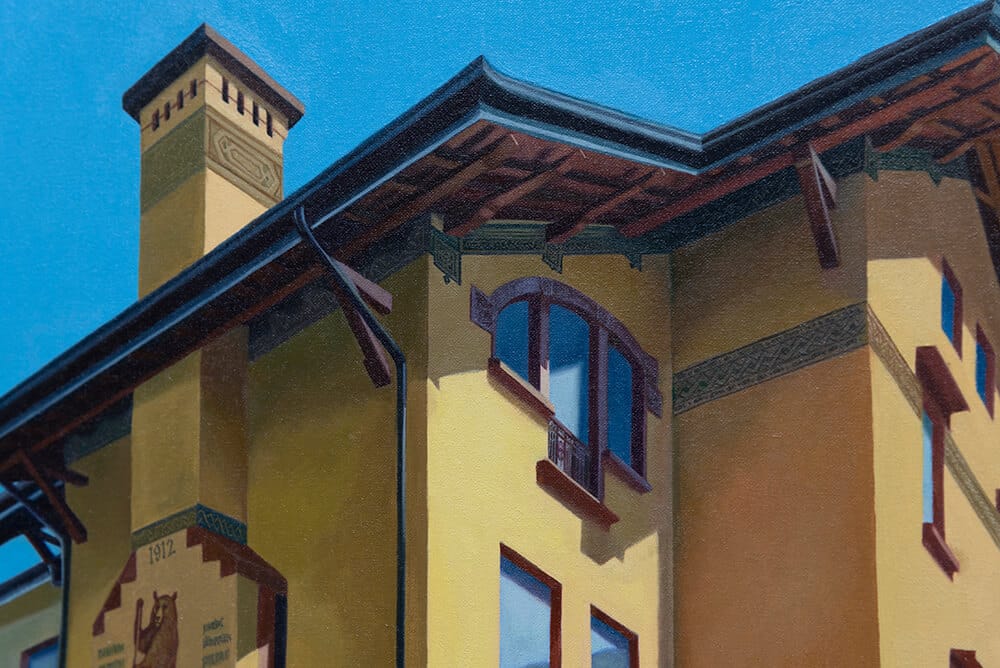
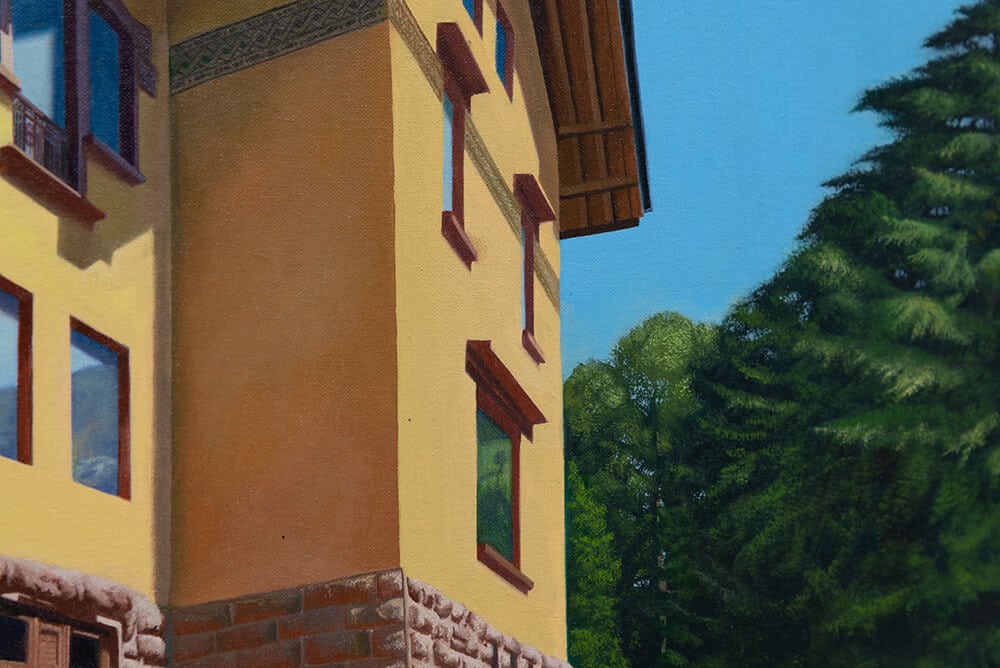
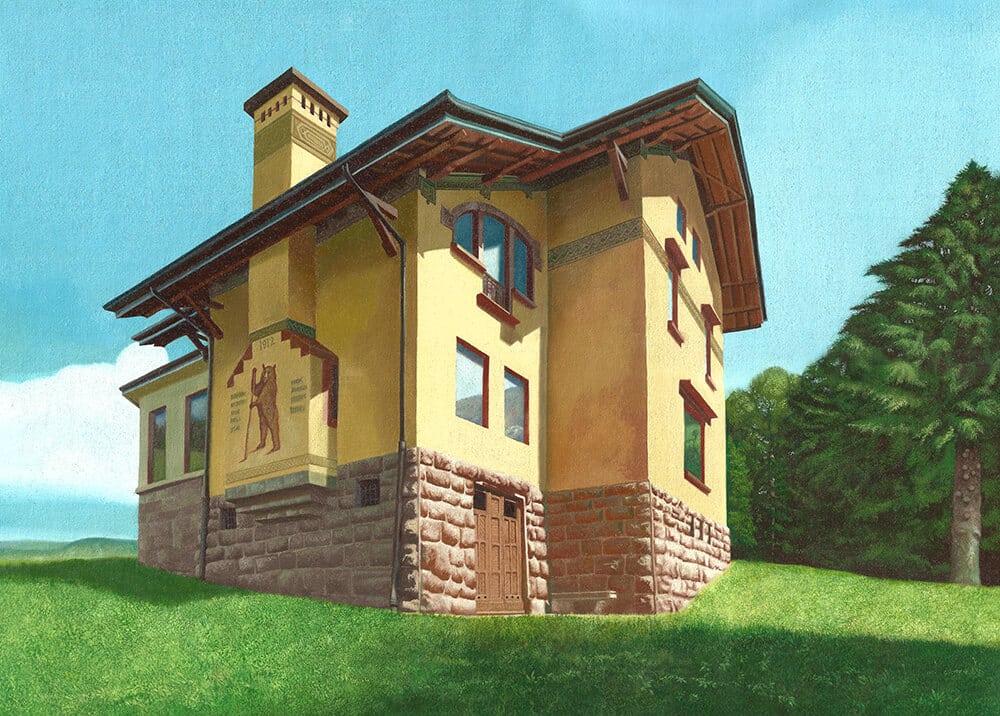
Villa Aventino for Gabriele Grones Come Alici, also Gabriele Grones (Arabba, 1983) chooses for the "Aventino" ** a look from below** that brings out architecture with its form of monumentality, but if Alici softens the size and presence by thinning the body and space in the soft and dreamy treatment of colors, Grones chooses instead ** the** full daylight** and the atmosphere of a clear spring day. The air of this Bossico is crystal clear and clean, still vaguely sharp, but open to the gaze and its many perspectives that open from the plateau on the lake and its territory. Grones captures the Villa in one of its distinctive traits, that is the Latin writing painted outside at the fireplace (it is difficult to touch the fearsome bear resting on the stick, the Aventine offers peace and gladness), with the image of the bear and the date of construction of 1912. To achieve this cut, the artist selected a set of photos of the Villa and its surroundings and analyzed its composition and details by facing the work as if it were a portrait. \ I tried to identify the general form and details to be highlighted (such as the parietal painting with the writing or the stone level on view), in order to create a dense image of details but balanced. I inserted some pieces of the landscape that stretches out in front of the villa that are reflected in the windows that give on the side of the lake, to suggest the relationship with space. \
What results from this approach and from this mode, is therefore a language characterized by a remarkable precision, but never didactic in its report the image: the "doing" of Grones presupposes in fact that the iconographic and photographic study follows ** the passage of different layers and different veils** that remove the image from its here and now, to bring it in a more personal and intimate dimension, in which the elaboration of details and atmospheres is carried out in a gradual and in a similar way to a real path of understanding and knowledge between the painted subject and the artist.
In the specific case of the Aventine, Grones then chooses to tell his symbolic vision** of the house, the spirit that the family wanted to give to the place, and his deep and fluid dialogue with the spaces that surround it, and that are reflected in the windows. In his portrait of the house are absorbed and reflected the shadows, the fronds and the white clouds set on the clear sky, which return together with the bright green of the meadows in this virtuous painting, in which every minimum element, from the leaf to the grass thread, is treated with care and meticulous attention, and is moved by a sparkling and light breeze, which is both in the environment and in the human attitude of those who live these places.
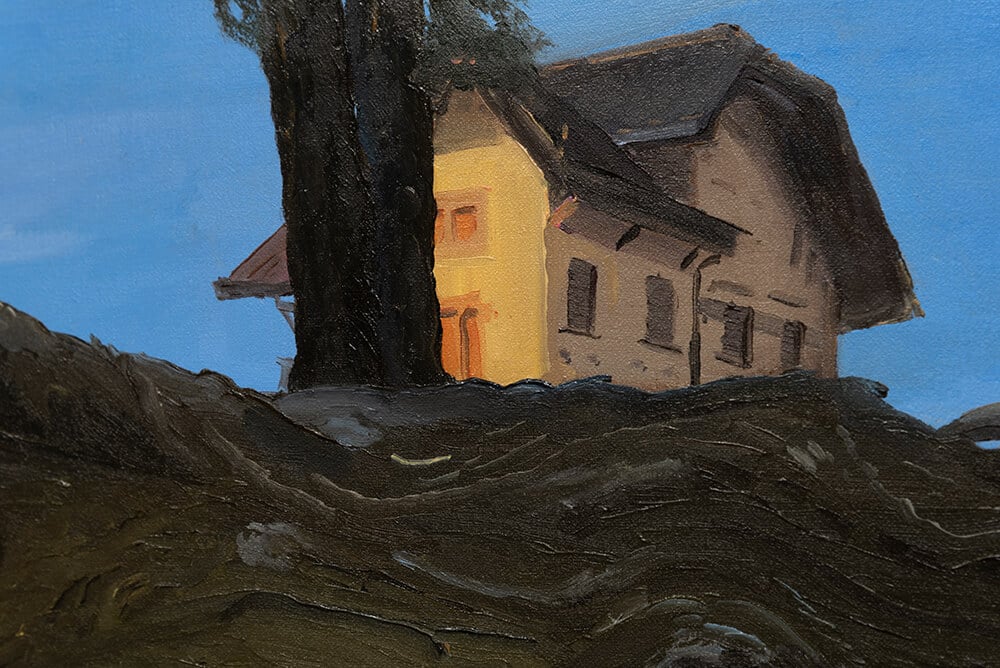
Villa Aventino for Michele Tocca Michele Tocca (Subiaco, 1983) in his canvas follows the visual path that accompanies the ascent along the hill on which the Aventine rises. The practice by the artist is based on periods of observation in which the knowledge of the places and of the space ** is gradually accomplished** through the detection of even minimal signs, which however coincide with acts of truth and vibrant intensity.
The footprints in the mud, the traces of a passage, the cracks in the surfaces tell the insertion of time in the places: the work, which according to a done now consolidated in the search for Tocca, is painted from the truth, chooses a point of view from below and uses elements really present in the context to imprint the story. In fact, in the foreground, a green trunk that is located at the top of the ascent leading to the entrance of the villa, is used as a stand on which to rest the canvas: this frame, of which the ribs and movements are taken and on which the light rests leaning, acts essentially as a viewfinder and observatory to lead the gaze and move in space. From this trunk is born a crossing between the identity of the context and that of his experience, which realizes in the same perspective the dimension of man and that of the environment. This concept of A simple place for Tocca, a solid, certain and not monumental appearance, whose identity translates the gap between distance and approach: the Aventine in this perspective is not simply an architecture, but a unicuum with a landscape understood as its natural and naturally integral part. Moreover, what each of these artists has returned to the Villa, is its being a coacervo of sensations, tensions and crossings, and in which the deeply pictorial nature of the place is integrated into a sure and conscious human identity. Those who chose these places, generation after generation, embraced the long perspectives of space to ** look across history and time**, telling of the past, the imaginary attitudes and the daily dimension of the present: and that's why, perhaps, Tocca says, walking those streets and suddenly seeing the Villa, you have the feeling that the Aventine is part of ** a painting already painted**.
Note 1 N. Bonfadini, •Laltipiano di Bossico dominating the Sebino • in Rivista di Bergamo, 1932, p. 291. •L'autore*** Elena Forin is an independent art critic and curator. She began her research working on the creation of archives dedicated to Italian and international artists of the 1950s and 1960s, such as Conrad Marca-Relli. She joined this study with similar investigations on currents of the 1970s and on the development of current research. From 2009 to 2011 he joined his independent activity for MACRO, Museo d'Arte Contemporanea Roma, for which he curated several exhibitions, including Urs Lüthi .Just Another Story About Leaving, Jacob Hashimoto Since 2011 he has been part of the curatorial collective LaRete Artprojects, created by Julia Draganovic and Claudia Löffelholz. Recent is his collaboration with the video collective ›The Eye of the Collector › video from Manuel De Santaren’s collection” (Mambo – Villa delle Rose, Bologna). Together with Julia Draganovic, she curates the second “Click or Clash? Collaboration Strategies” event, dedicated to Marco Giovani, Niklas Goldbach and Yves Netzhammer.
Schiavi Spa thanks Elena for her kind collaboration and availability.
To view videos, enable external content in your cookie preferences.