Completed in 1912 by the Schiavi family, it is one of the most recognizable buildings of the entire province of Bergamo
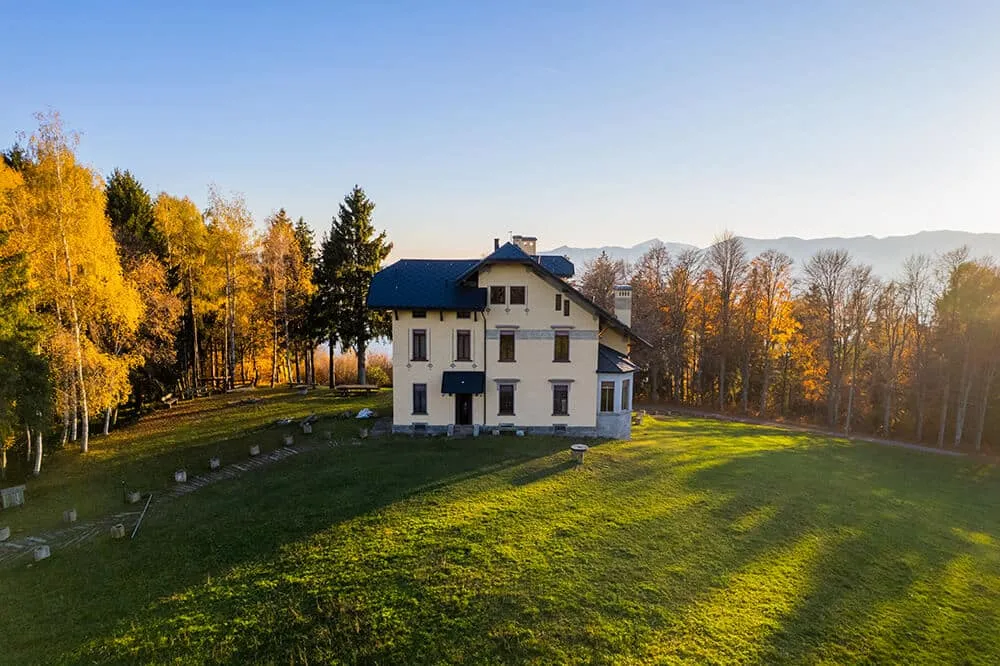
For aesthetics, history and integration with the surrounding territory, Villa Aventino is one of the most recognizable and emblematic buildings of Bossico and the entire province of Bergamo for more than a century. The construction of the original work, commissioned by the then owners Ventura Gregorini to the Schiavi Family, already at the time synonymous with the very act of building, dates back to 1912.
Located on the edge of the vast meadows of Stà, near the Mount of Lovere, Villa Aventino takes its name from one of the seven hills of ancient Rome, transforming in a short time into a tangible and vibrant symbol of the cultural values and political ideals that characterized the territory between the end of the nineteenth century and the beginning of the twentieth.
Immersed in the breathtaking beauty of the Bossico plateau, surrounded by dense pine forests and valleys and with a look at the blue waters of Lake Iseo, the villa has established itself over the decades as an icon of local history and culture, but also as a tangible manifestation of the harmonious coexistence between man and nature.
A house of delight that is also cultural lounge and small temple of art
Villa Aventino is not only a virtuous example of beautiful and functional architecture, but also a small temple of art capable of embodying the passion of the Ventura Gregorini for literature, music, dissertation and painting. Over the years, its rooms have in fact hosted thinkers, musicians and renowned Bergamo artists such as Giovanni Trussardi Volpi, Cesare Tallone, Francesco Domenighini and Giorgio Oprandi.
Among family portraits, frescoes that enrich the walls of the interiors and sublime natural landscapes, each of these artists has contributed to make the rooms of the residence a precious private museum, as well as to shape its artistic identity and define its role in the history of contemporary art: Villa Aventino as a magical place where nature finds its breath and voice, speaking to man; Villa Aventino as a source of inspiration; Villa Aventino as an art gallery. One architecture that gathers a thousand souls, many languages and countless interpretations, making itself a guardian of the emotions and perceptions of those who attend it. Progressively, the villa opens up more and more to the community of which it belongs. From the 1930s onwards, it thus becomes a center for public events and cultural initiatives, as well as a place to displeasure politics, art and literature and to listen to operas. Its prestige is such that, in the 1980s, even Bettino Craxi visit, recognizing its high historical, architectural and artistic-cultural value.