The significant increase in the atmosphere of the greenhouse gas**, with its heavy climate-wide impact**, is a problem that is now impossible to ignore and that must be metigated by every possible means**.
Without prejudice to the need for any productive sector to implement more sustainable processes from an environmental and energy point of view, the building sector plays a major role today in contrast to global warming. Late summer 2022 marked ** record temperatures** in urban centres throughout Europe and, with the arrival of the new year, the search for new strategies and solutions to counter a problem that is inevitably destined to repeat in the coming months. In this sense, research does not lie: a study carried out by JRC of the European CommissionThe EC Joint Research Centre analysed the difference between the earth-temperatures** in cities with a population of more than fifty thousand inhabitants and those in neighbouring rural areas in a time span of from 2003 to 2020, discovering that this can reach 10-15 degrees due to the devastating effect of the heat island** : this is a phenomenon that produces a microclimate warmer in highly urbanised spaces, resulting in increased health risk** ** of citizens** and heavy impacts at economic and environmental level. ** UN report**, moreover, it is not to be excluded that by the 2050 the * urban heat stress** , can reduce the working capacity of people ** by 20% in the summer months**. The stakes are therefore very high for two fundamental reasons: the global warming impacts every aspect of the life of man, and about 75% of Europeans live in urban areas. But how is it possible to solve**?
To date, cities have been built using mainly cement, asphalt, metal and glass**: these materials are however designed for ** completely different climates** and do not contribute at all to counter the increase in temperatures. urban spaces must therefore be rethought in full: in materials and shapes, density and mobility, in energy management and waste management. Here is a small practical example: for decades the cyclable tracks have been made using cement or asphalt, certainly pleasant to see but not very sustainable. In the future, the choice of materials could be based on the ** earth beat** or on particular types of ** epoxy resins** which, thanks to specific treatments and additives, avoid the stagnation of water and the formation of heat islands. But this is only ** one of the possible routes** for the urban planning of tomorrow. Let's see, in summary, which are the directors indicated as effective by the European Union with regard to buildings.
For cities: smarter energy consumption to reduce CO2 emissions Urban areas** are responsible alone 60-80% of energy consumption worldwide and, in effect, as many CO2 emissions. Reducing their carbon footprint is therefore the first goal to be pursued. Roads that can be travelled are different in this sense and provide for the collaboration of local institutions** to achieve:
- Promotion of energy efficiency** and use of energy from renewable sources**
- Planning of sustainable transport systems and promoting alternative transport methods in cities, such as car sharing and bike sharing.
- Construction of city infrastructure capable of supporting extreme weather events (from extreme heat to extreme cold, from clouds to floods, to violent hailstorms and so forth).
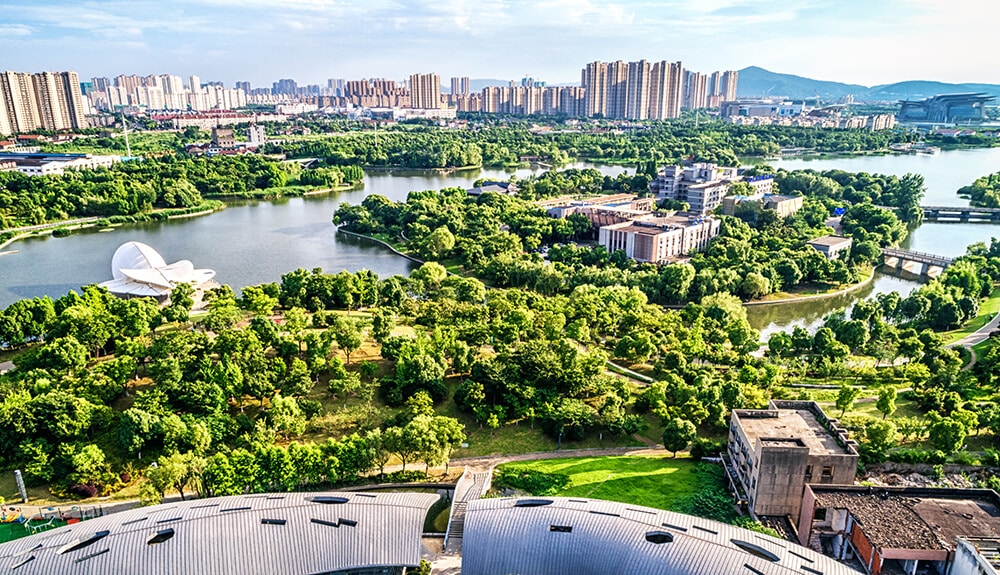
- Development of urban green areas** and new roads that can also be used as drain channels for rain**. More specifically, the construction sector** will see the use of so-called "intelligent materials**" as the concrete reinforced carbon fibre, the enhanced wood and the so-called bio-compound construction materials, to which we had been able to develop. dedicated an article The experience of Coronavirus and lockdown also prompted the Rethinking living spaces, making them more human-sized**: The needs of daily living have changed, and in the near future easier access to the outside and greater communication with nature are expected**. Tomorrow's buildings will also have to be energy efficient, especially if we consider that a considerable portion of the energy we use today is used precisely to heat and cool our homes, schools, offices. From the installation of triple glass windows to the absolute attention to the insulation systems of the building, to the ever more massive integration of green on roofs and facades (think for example of roofs covered with plants, very useful because they can hold rainwater and isolate from the heat and cold), the goal is to create cities more livable and comfortable, less polluting and more able to withstand the new extreme climates
It is in this interesting sense to note that, already today, there are several cities in Europe that have begun to integrate vegetation into buildings, both on walls and roofs. Live green absorbs heat, acts as a thermal acoustic insulation, improves the microclimate and increases the quality of living • because man needs contact with nature! In France and Denmark, for example, all buildings must have, by law, green covers.
To view videos, enable external content in your cookie preferences.